

par Banyan Gold Corp. (CVE:BYN)
Banyan Gold Intersects 1.88 g/t Gold over 17.9 Metres in the Gap Between Airstrip and Powerline, and Identifies High-Grade Gold in Airstrip Footwall at AurMac, Yukon, Canada
VANCOUVER, BC / ACCESS Newswire / October 6, 2026 / Banyan Gold Corp. (the "Company" or "Banyan") (TSXV:BYN)(OTCQB:BYAGF) is pleased to report new results from the Airstrip Deposit ("Airstrip") and the gap between the Airstrip and Powerline Deposit at its AurMac Project ("AurMac"), Yukon, Canada. Drillhole AX-26-942 intersected 1.01 g/t gold ("Au") over 36.1 metres ("m") from 9.0 m downhole, including 1.88 g/t Au over 17.9 m from 27.2 m downhole and 28.70 g/t Au over 0.8 m, between the Airstrip and Powerline deposits. Mineralization is associated with large extensional quartz veins containing numerous grains of visible gold, with associated bismuth sulphosalts and sulphide mineralization. In Airstrip, drillholes AX-26-729 and -730 returned 1.19 g/t Au over 12.1 m and 6.79 g/t Au over 3.3 m, respectively. Mineralization in these holes is associated with replacement-style mineralization in calc-silicate altered horizons in the Airstrip footwall and lower Cal 2 horizon.
The results identify higher-grade, near-surface mineralization in the gap between Airstrip and Powerline and identify additional high-grade Airstrip horizons outside the current conceptual pit boundary. The drilling forms part of Banyan's ongoing work to improve confidence in the resource model, test higher-grade targets and resource expansion opportunities, and establish AurMac's development potential.
Highlights from Airstrip and North Powerline area:
AX-26-729 - 5.59 g/t Au over 2.0 m, within 1.19 g/t Au over 12.1 m; including 10.10 g/t Au over 0.9m
AX-26-730 - 6.79 g/t Au over 3.3 m, including 9.90 g/t Au over 1.0 m and 13.50 g/t Au over 0.8 m
AX-26-942 - 1.88 g/t Au over 17.9 m, within 1.01 g/t Au over 36.1 m
AX-26-897 - 0.96 g/t Au over 27.5 m, including 4.12 g/t Au over 5.1 m
AX-26-899 - 0.84 g/t Au over 5.4 m, and 5.76 g/t Au over 1.7 m
*Note: drillholes AX-26-729 and -730 were drilled in 2025 and analysed in 2026.
"The intersection of 1.88 g/t Au over 17.9 m in AX-26-942 highlights the potential for higher-grade near-surface mineralization in the largely undrilled gap between Airstrip and Powerline," stated Tara Christie, President and CEO. "The Airstrip footwall results identify additional higher-grade targets for follow-up. AurMac already has significant scale and our focus is on improving resource confidence and defining higher-grade areas that could contribute to a mine plan. Our first Preliminary Economic Assessment is targeted for completion in the fourth quarter of 2026 and will evaluate AurMac's economic potential. These results reinforce that exploration opportunities remain at AurMac, alongside the early discoveries at Nitra. Our strengthened treasury gives us the flexibility to pursue this work, with disciplined spending directed toward results and strategic milestones."

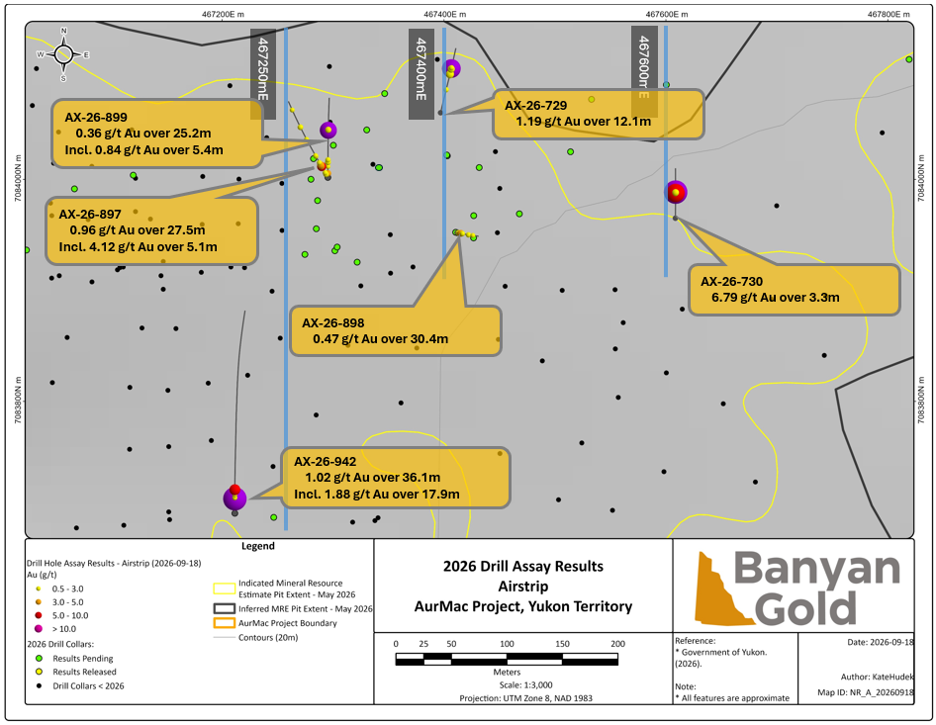
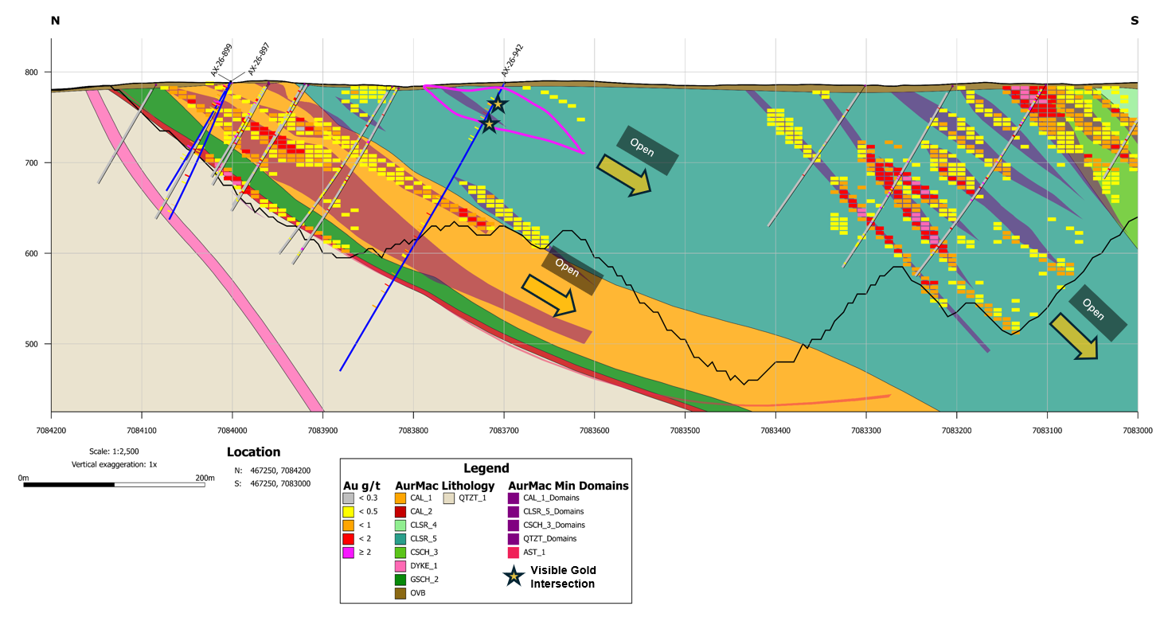
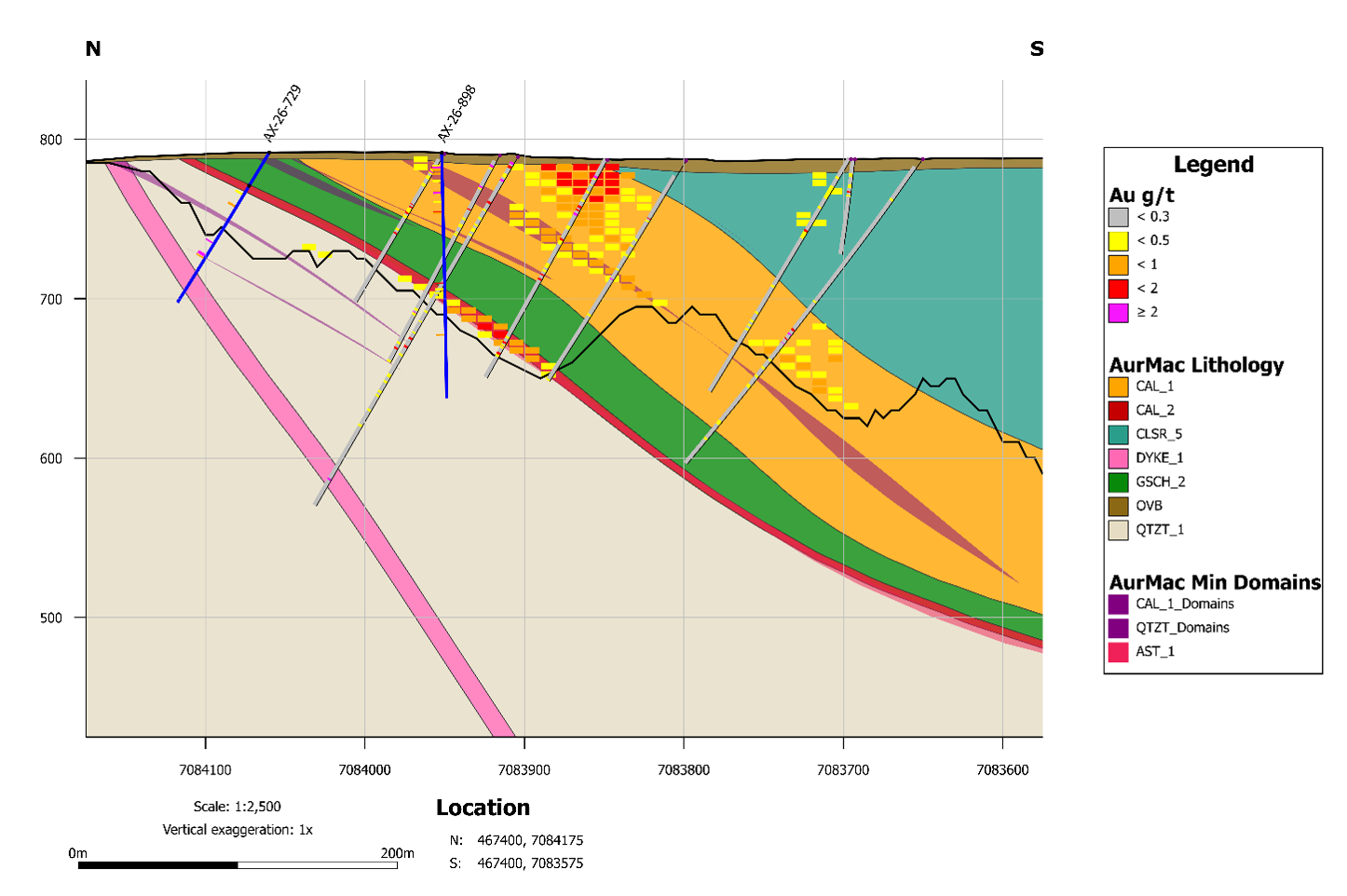
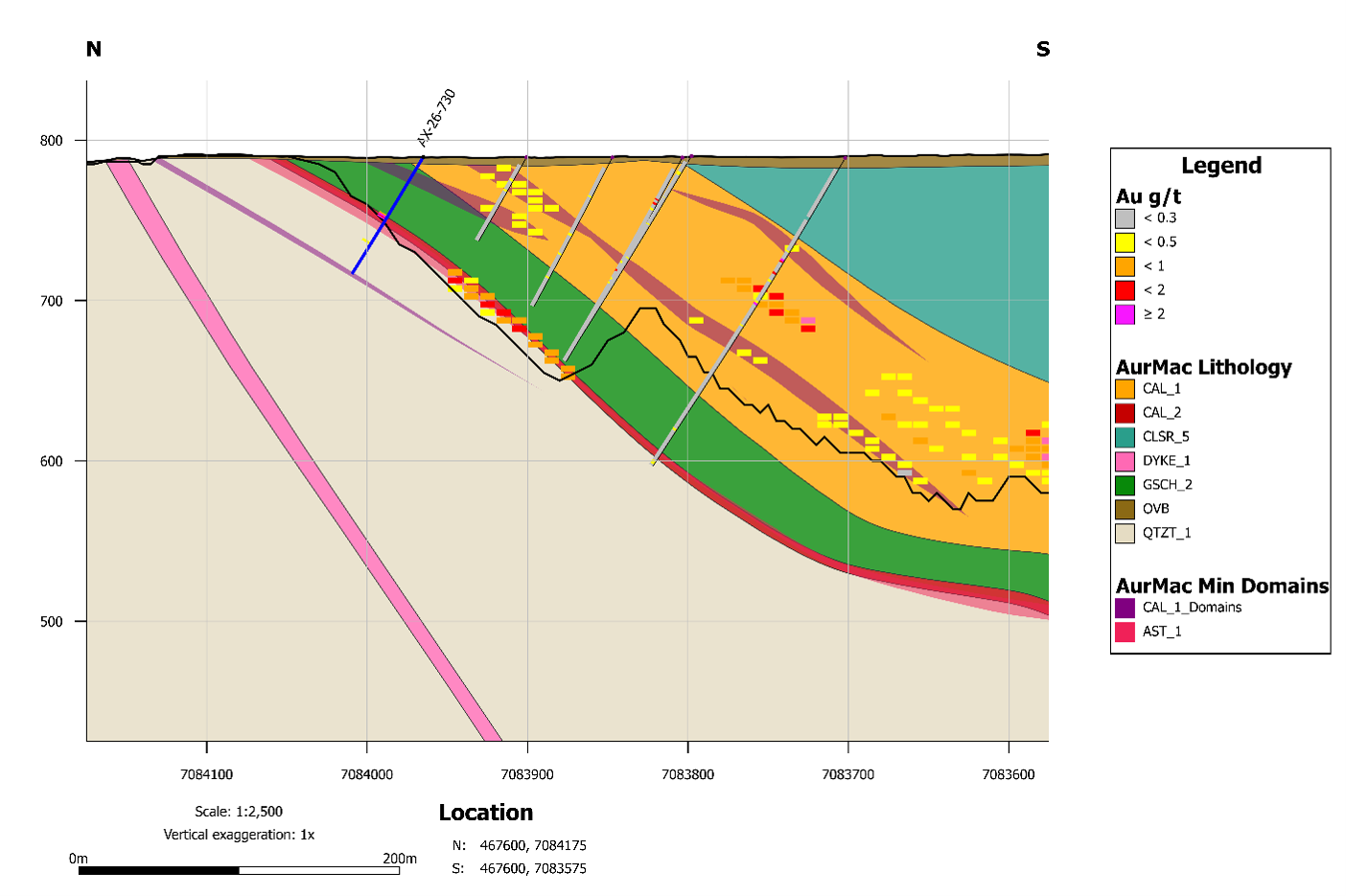
Lithological domains at Powerline are dominated by metasedimentary rocks of various compositions, typically mica-chlorite schists with varying calcareous content. Domains shown in this section are: CLSR_4 and 5 - chlorite-sericite schist; CSCH_1 and 3 - calcareous schist; and sch_2 - heterogeneous schist. Altered host rocks with intense silicification and meta-greenstones are the preferential hosts for extensional quartz veining (Figures 6 and 7). Lithologic domains at Airstrip are dominated by calcareous metasedimentary rocks that readily undergo calc-silicate alteration and sulphide replacement mineralization (Figures 9 and 10). Calcareous metasedimentary rocks overlie quartzites. Domains Cal_1 and Cal_2 - calcareous metasedimentary rocks are the primary host for gold mineralization at Airstrip, with extensional quartz veins hosted in the quartzite ("QTZT").
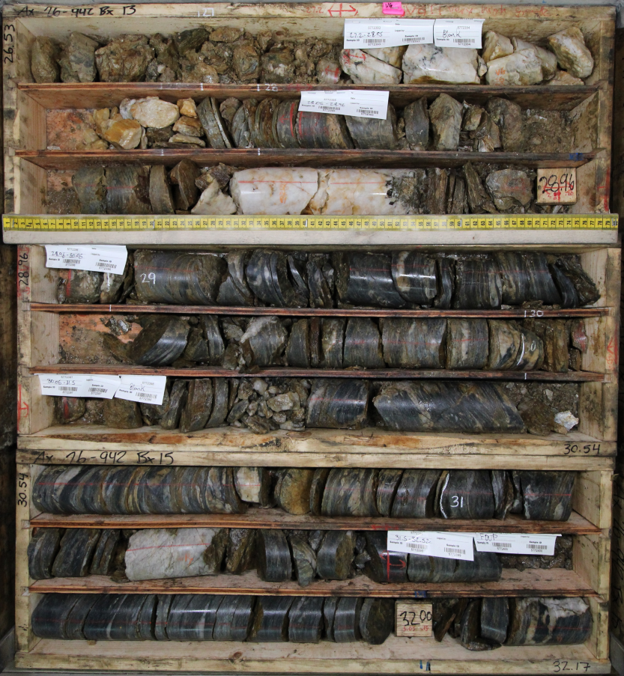
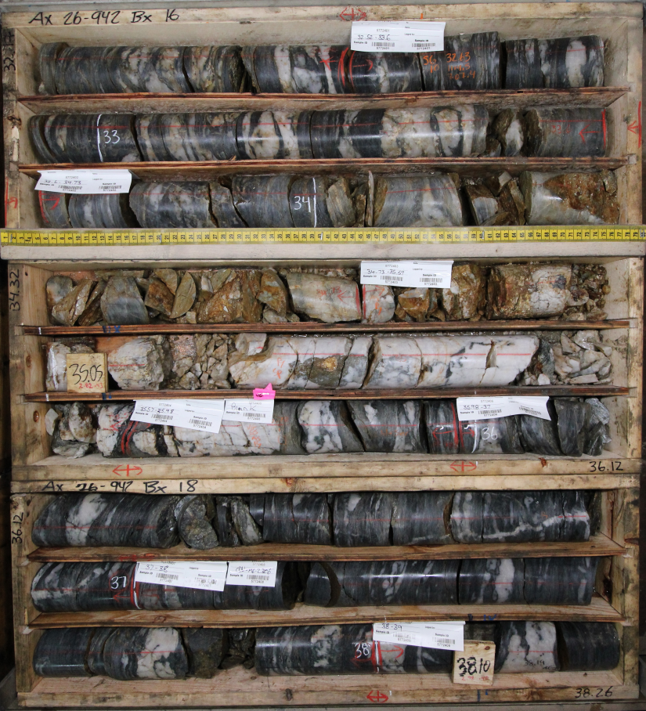
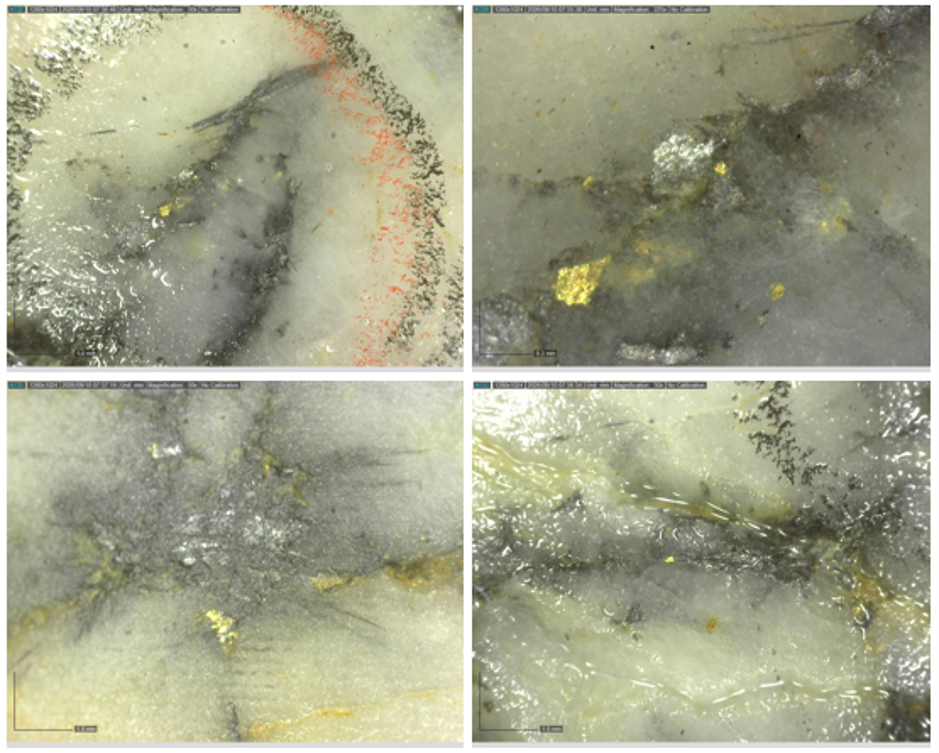
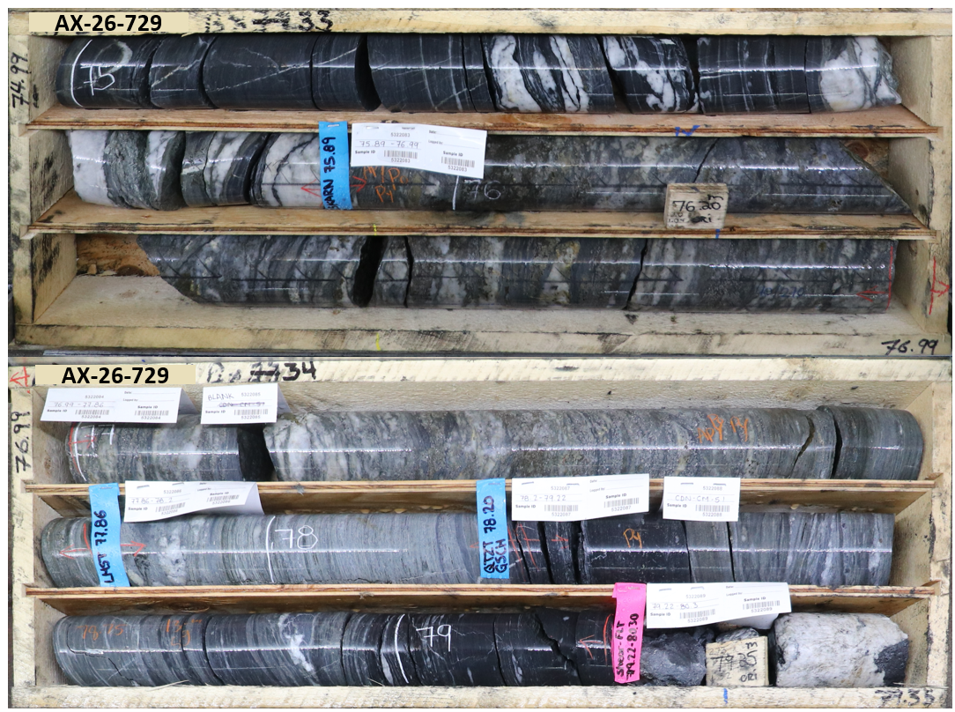
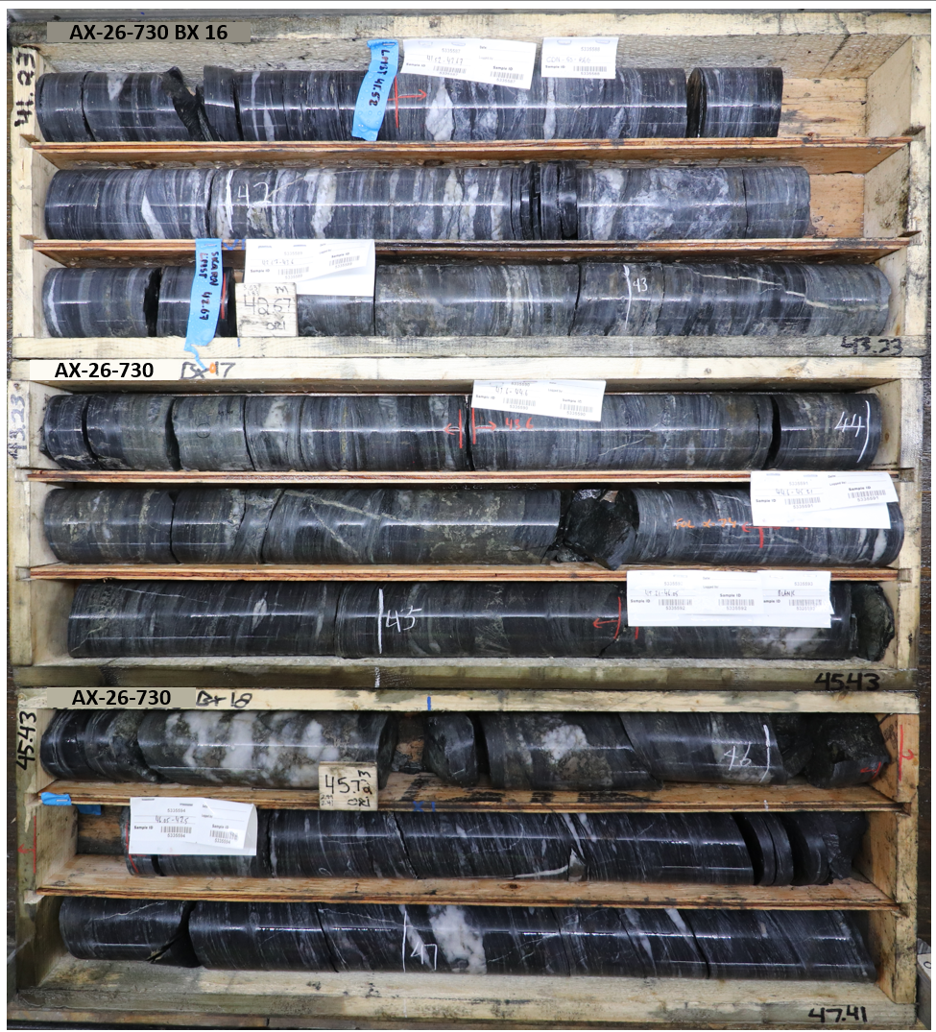
Table 1: Intervals from Airstrip and Powerline
| HOLE NUMBER | Depth From (m) | Depth To (m) | Au Interval (m) | Au Grade (g/t) |
| AX-26-729 | 67.1 | 79.2 | 12.1 | 1.19 |
| including | 75.9 | 77.9 | 2.0 | 5.59 |
| including | 77.0 | 77.9 | 0.9 | 10.10 |
| AX-26-730 | 42.7 | 46.0 | 3.3 | 6.79 |
| including | 43.6 | 44.6 | 1.0 | 9.90 |
| and including | 45.2 | 46.0 | 0.8 | 13.50 |
| AX-26-897 | 6.2 | 11.8 | 5.6 | 0.66 |
| including | 7.2 | 8.5 | 1.3 | 1.86 |
| and | 25.8 | 53.3 | 27.5 | 0.96 |
| including | 25.8 | 30.9 | 5.1 | 4.12 |
| including | 25.8 | 27.2 | 1.4 | 7.05 |
| and | 116.5 | 126.5 | 10.0 | 0.36 |
| including | 116.5 | 118.0 | 1.5 | 1.73 |
| AX-26-898 | 8.5 | 38.9 | 30.4 | 0.47 |
| including | 8.5 | 10.0 | 1.5 | 2.20 |
| and including | 24.8 | 26.0 | 1.2 | 3.58 |
| and including | 36.9 | 37.5 | 0.6 | 1.33 |
| and | 82.0 | 92.2 | 10.2 | 0.35 |
| including | 82.0 | 83.0 | 1.0 | 1.26 |
| AX-26-899 | 7.1 | 32.3 | 25.2 | 0.36 |
| including | 7.1 | 7.7 | 0.6 | 3.26 |
| and including | 26.9 | 32.3 | 5.4 | 0.84 |
| including | 26.9 | 28.1 | 1.2 | 2.10 |
| and including | 31.1 | 32.3 | 1.2 | 1.26 |
| and | 84.3 | 86.0 | 1.7 | 5.76 |
| including | 84.3 | 84.6 | 0.3 | 19.10 |
| AX-26-942 | 9.0 | 45.1 | 36.1 | 1.01 |
| including | 27.2 | 45.1 | 17.9 | 1.88 |
| including | 27.2 | 28.0 | 0.8 | 28.70 |
| and including | 39.6 | 40.0 | 0.4 | 1.00 |
| and including | 44.5 | 45.1 | 0.6 | 9.71 |
| and | 167.0 | 197.0 | 30.0 | 0.19 |
| including | 167.0 | 168.1 | 1.1 | 1.07 |
| and including | 196.2 | 197.0 | 0.8 | 1.49 |
| and | 213.8 | 216.3 | 2.5 | 0.80 |
| including | 215.1 | 215.8 | 0.7 | 1.18 |
| and | 257.9 | 259.0 | 1.1 | 1.05 |
Note: Calculated true widths are approximate and vary by drillhole; see Table 2
Table 2: Collars for diamond drillholes in this release
Hole ID | Easting (m) | Northing (m) | Elevation (m) | Length (m) | Azimuth | Dip | Calc. True Width (%) |
AX-26-729 | 467397 | 7084060 | 792 | 111.3 | 0 | -60 | 95 |
AX-26-730 | 467609 | 7083965 | 789 | 85.3 | 0 | -60 | 95 |
AX-26-897 | 467295 | 7084002 | 790 | 170.7 | 330 | -65 | 90 |
AX-26-898 | 467412 | 7083952 | 792 | 155.5 | 98 | -82 | 95 |
AX-26-899 | 467295 | 7084002 | 790 | 140.2 | 360 | -60 | 95 |
AX-26-942 | 467212 | 7083699 | 788 | 367.0 | 1 | -62 | 90 |
Analytical Method and Quality Assurance/Quality Control Measures
The reported work was completed using industry standard procedures and a quality assurance/quality control ("QA/QC") program consisting of the insertion of certified reference materials, field duplicates and coarse blanks into the sample stream and utilizing certified independent analytical laboratories for all assays.
The Qualified Persons reviewed the available QA/QC data and identified no material issues.
Standards, core duplicates and coarse blanks represented approximately 10% of samples submitted during the 2026 drilling program. Results were monitored as analytical data became available and were within the accuracy and precision thresholds established for the program.
Banyan personnel systematically logged and photographed all diamond drill core. HTW- and NTW-diameter core was split at Banyan's core-processing facilities. One half was returned to the core box and the other was sealed in a poly bag with one part of a three-part sample tag. Banyan personnel or a dedicated expediter delivered samples to the Bureau Veritas ("BV") preparation laboratory in Whitehorse or to AGAT Laboratories' Geochemical Mining Division in Calgary ("AGAT"). Samples prepared by BV were shipped to its analytical laboratory in Vancouver, British Columbia. AGAT samples were prepared, pulverized and analyzed in Calgary, Alberta, or Thunder Bay, Ontario.
BV analyzed samples using four-acid digestion and either its MA-200 ICP-ES 45-element package or MA-250 ICP-ES/MS 59-element package, together with FA-450 50 g fire assay with an AAS finish for gold. Samples returning more than 10 g/t Au were reanalyzed by FA-550 fire assay with a gravimetric finish. High-grade samples containing documented visible gold were also analyzed by FS-652 metallic-screen fire assay. Silver overlimits were analyzed using MA-370, FA-550 or FA-501, as applicable. Bureau Veritas is accredited to ISO/IEC 17025:2017 under SCC File No. 15895.
AGAT analyzed samples using four-acid digestion and its 201-071 ICP-OES/ICP-MS 48-element package, together with 201-551 50 g fire assay with an AAS finish for gold. Samples returning more than 10 g/t Au were reanalyzed by 202-551 fire assay with a gravimetric finish. High-grade samples containing documented visible gold were also analyzed by 202-131 metallic-screen fire assay. Samples returning more than 100 g/t Ag were analyzed using 201-470. AGAT is accredited to ISO/IEC 17025:2017 under SCC File Nos. 151266 and 151083.
Qualified Persons
Duncan Mackay, M.Sc., P.Geo., is a "Qualified Person" as defined under National Instrument 43-101, Standards of Disclosure for Mineral Projects ("NI 43-101"), and has reviewed and approved the content of this news release in respect of all disclosure other than the MRE. Mr. Mackay is Vice President Exploration for Banyan and has verified the data disclosed in this news release, including the sampling, analytical and test data underlying the information.
Upcoming Events
- The MoneyShow Orlando, October 5-7, 2026
- Atlanta Roadshow, October 9-10, 2026
- 121 Mining Investment Global Online, October 14-15, 2026
- New Orleans Investment Conference, October 28-31, 2026
About Banyan
Banyan's primary asset, the AurMac Project, is located in the Traditional Territory of the First Nation of Na-Cho Nyäk Dun, in Canada's Yukon Territory. The AurMac Project comprises two main deposits, the Airstrip and Powerline Deposits. Mineralization is characteristic of a Reduced Intrusion Related Gold system, hosted in auriferous cross-cutting sheeted quartz veins and replacement-style mineralization hosted in skarn horizons. The current Mineral Resource Estimate ("MRE") for the AurMac Project has an effective date of May 15, 2026 and comprises an Indicated Mineral Resource of 3.639 million ounces of gold ("Au") (167.3 M tonnes at 0.68 g/t) and an Inferred Mineral Resource of 4.985 Moz of Au (267.2 M tonnes at 0.58 g/t) (See MRE Table 3 below; as defined in the 2014 CIM Definition Standards for Mineral Resources and Mineral Reserves incorporated by reference into NI 43â101). The 303 square kilometres ("sq km") AurMac Project lies 40 kilometres from Mayo, Yukon. The AurMac Project is transected by the main Yukon highway and benefits from a 69 kV 3-phase powerline, existing power substation and cell phone coverage.
MRE Table 3: Pit-constrained Indicated and Inferred Mineral Resources - AurMac Project
Cut-off Grade | Tonnes | Gold Grade | Contained Gold | |
(Au g/t) | (M Tonnes) | (g/t) | (M Oz) | |
Indicated MRE | ||||
Airstrip | 0.30 | 37.7 | 0.69 | 0.840 |
Powerline | 0.30 | 129.5 | 0.67 | 2.799 |
Combined | 0.30 | 167.3 | 0.68 | 3.639 |
Inferred MRE | ||||
Airstrip | 0.30 | 15.1 | 0.84 | 0.405 |
Powerline | 0.30 | 252.1 | 0.57 | 4.580 |
Combined | 0.30 | 267.2 | 0.58 | |