

par Kalo Gold Corp. (CVE:KALO)
Kalo Gold Identifies High-Grade Gold-Silver Veins at Wainikoro, Vatu Aurum, Fiji
VANCOUVER, BC / ACCESS Newswire / September 8, 2026 / Kalo Gold Corp. (TSX-V:KALO)(OTCID:KLGDF)(FSE:9M51) ("Kalo", "Kalo Gold" or the "Company") is pleased to report high-grade gold and silver results from reconnaissance rock sampling at a newly identified target area in the northeast of Wainikoro.
Seven rock samples collected from a single, previously unsampled outcrop (the "New Vein Cluster" - Figures 2,3 and 4) returned gold assays of up to 7.83 g/t and silver assays of up to 108 g/t, with five of the seven samples returning greater than 2 g/t gold. The samples were taken from two intersecting sets of epithermal quartz veins exposed over approximately 15 metres of strike length. Neither vein set was closed off by the exposure; both are obscured along strike by overburden. The outcrop lies approximately 270 metres northeast of the principal Wainikoro graben structure, along the margin of a discrete magnetic low.
The Company continues its multi-disciplinary approach to strengthen its understanding of the Wainikoro epithermal system and provides an additional high-priority target for the ongoing geophysical survey program.
Highlights
Seven rock samples from a single, previously unsampled outcrop returned gold assays of up to 7.83 g/t and silver assays of up to 108 g/t.
Five of the seven samples returned greater than 2 g/t gold, and three returned greater than 4 g/t gold.
Gold and silver occur on two intersecting vein orientations - NNW-SSE and east-west - interpreted as at least two separate episodes of veining and hydrothermal activity. Neither vein set was closed off by the exposure; both are obscured along strike by overburden.
Veins display a classic low-sulphidation epithermal geochemical signature characterized by elevated gold, silver, arsenic, antimony, lead and zinc.
The veins occur along the margin of a discrete magnetic low, approximately 270 metres northeast of the principal Wainikoro graben structure.
Follow-up mapping, structural measurement and trench sampling are planned across the New Vein Cluster. Gradient array induced polarization (IP) and gravity surveys are underway across Wainikoro, with CSAMT scheduled to follow.
CEO Commentary
Terry L. Tucker, P.Geo., President and CEO of Kalo Gold, commented: "Seven samples from one outcrop, five of them above 2 g/t gold and the best at 7.83 g/t, is a strong return from ground we had not sampled before. What makes it more than a good rock sample is the structure. The gold and silver sit on two different vein orientations that cut one another, which tells us there has been more than one episode of hydrothermal activity in the same place, and neither set closed off at the exposure - both run under cover. That is the kind of target we want to follow up with trenching and to have the geophysics look underneath. With the gradient array IP and gravity surveys underway and CSAMT to follow, we expect to know a good deal more about what sits beneath this outcrop before the end of the year."
A New Priority Exploration Target
The newly identified target area is situated approximately 900 m northeast of 2026 drill hole VA26-DH19, northeast of the principal Wainikoro structural corridor and within predominantly andesitic volcanic rocks. Reconnaissance mapping identified a series of outcropping quartz veins over approximately 15 m of strike length, from which seven rock samples were collected. At the southern end of the exposure, the veins trend approximately NNW-SSE, before intersecting a second, approximately east-west trending vein set to the north. Both vein sets potentially remain open along strike but were obscured by overburden. Silicification extends outward from the vein margins into the host andesite, so the mineralized structures form composite silicified intervals rather than discrete veins with sharp walls; widths and continuity will be defined by the planned trenching and channel sampling. The contrasting orientations and observed cross-cutting relationships are currently interpreted to represent at least two separate episodes of veining and hydrothermal activity, highlighting the structural complexity of the target. The veins exhibit chalcedonic and other textures characteristic of low-sulphidation epithermal systems, with samples also containing apparent sulphosalt mineralization. The consistency of elevated gold and silver grades across multiple samples and vein orientations suggests the area may represent a coherent, multi-stage mineralized system rather than isolated vein occurrences.
All new high-grade precious metal samples from the reconnaissance sampling program originate exclusively from the location labelled New Vein Cluster (Figure 2), as detailed in the laboratory results below:
Sample ID | Easting | Northing | Au (g/t) | Ag (g/t) | Notes |
315959 | 775469 | 8192834 | 7.83 | 99.7 | Samples from NNW-SSE trending vein |
315960 | 775469 | 8192834 | 1.39 | 25.9 | |
315962 | 775467 | 8192838 | 5.36 | 54.6 | Samples from W-E trending vein |
315963 | 2.10 | 33.7 | |||
315964 | 2.32 | 77.1 | |||
315965 | 4.02 | 105 | |||
315971 | 775469 | 8192834 | 1.35 | 108 | Sample from NNW-SSE trending vein |
Coordinates are reported in UTM Zone 60 South (WGS84 datum). Multiple samples were collected from separate veins and vein splays exposed within the same outcrop. Grab, float and rock chip samples are selective by nature and are not necessarily representative of the mineralization on the property.
Integration with the Wainikoro Exploration Model
The new target forms part of the Company's evolving interpretation of the Wainikoro epithermal system.
Rather than representing a simple extension of the principal Wainikoro graben target, the northeastern target may represent an additional structurally focused hydrothermal centre developed along subsidiary fault systems adjacent to the regional graben. Recognition of multiple mineralized structural corridors would expand the exploration potential of the Wainikoro area.
The ongoing geophysical program has been designed to evaluate these structural relationships and identify resistivity, chargeability and density contrasts that may indicate concealed extensions of the mineralized system beneath surface.
Geological Interpretation
Multi-element geochemistry indicates the veins exhibit a classic low-sulphidation epithermal signature characterized by elevated arsenic, antimony, lead and zinc associated with precious-metal mineralization. Copper concentrations remain relatively low, suggesting the mineralization represents a precious-metal-dominant hydrothermal system rather than a base-metal-rich vein.
Structural measurements collected during mapping indicate that the highest-grade mineralization is associated predominantly with east-west striking veins, although additional mineralized northeast- and north-northwest-oriented vein sets have also been recognized elsewhere within the Wainikoro target area. The Company believes these observations may reflect multiple generations of structurally controlled fluid flow within the broader hydrothermal system.
The Company cautions that these geological interpretations remain conceptual and will be evaluated through the ongoing and planned IP, gravity and CSAMT geophysical surveys.
Next Steps
At the New Vein Cluster, the Company plans follow-up geological mapping and structural measurement, channel sampling of the exposed veins, and trenching across both vein sets to test their extensions beneath overburden.
Ground geophysical surveying by Fender Geophysics Pty Ltd is underway across Wainikoro. The program comprises gradient array induced polarization (IP), gravity and Controlled-Source Audio-frequency Magnetotellurics (CSAMT). The current survey schedule is as follows:
Gradient array IP - commenced 31 July 2026; surveying of five of the eight survey blocks has been completed, and surveying of the remaining blocks is scheduled for completion by late September 2026.
Gravity - commenced 14 August 2026 and scheduled for completion in late September 2026.
CSAMT - scheduled to commence in late September 2026 and to continue into October 2026.
Integrated interpretation and final geophysical reporting - scheduled for November 2026.
Results from the surveys will be integrated with geological mapping, soil geochemistry, airborne magnetic and radiometric data and laboratory analyses to refine the Company's geological model and prioritize future drill targets. Survey timing remains subject to weather, ground access, and crew and equipment scheduling.
Quality Assurance / Quality Control
Gold assays reported in this news release were determined by ALS Limited (Australia) using method Au-AA25 (30 g Fire Assay, AAS Finish). Silver and multi-element results were determined by ALS Limited (Australia) using method ME-MS61 four acid digest with ICP-MS instruments on a 0.25 g sample; samples returning silver above the upper detection limit of 100 g/t were re-analysed using ore-grade method Ag-OG62 by four acid digest and ICP-AES. ALS is accredited by NATA to ISO/IEC 17025 and is independent of the Company and the Qualified Person. Certified reference materials, blanks, pulp duplicates and preparation duplicates were inserted into the sample stream at regular intervals and have been reviewed by the Qualified Person.
Qualified Person
The technical information in this news release was prepared, reviewed, and approved by Andrew Randell, P.Geo., CEO and Principal Geoscientist of SGDS-Hive, Technical Director of the Vatu Aurum Project, and a Qualified Person as defined by NI 43-101. Mr. Randell is independent of the Company and has verified the data disclosed, having conducted multiple site visits (2023-2026) and direct supervision of the exploration program.
About Kalo Gold Corp.
Kalo Gold Corp. is a gold exploration company advancing the 100%-owned Vatu Aurum Project (Special Prospecting Licences 1511 and 1464), a 367 km² land package on Vanua Levu, Fiji, located in a preserved volcanic back-arc setting. The Company's work is focused on a northeast-trending corridor of low-sulphidation epithermal gold targets. Exploration across the corridor - including at the flagship Aurum Prime area and Wainikoro - has defined multiple structurally controlled gold targets supported by drilling, trenching, soil geochemistry, structural mapping and airborne geophysics. The Company is systematically advancing high-confidence targets toward potential discovery.
Kalo Gold Corp. is headquartered in Vancouver, British Columbia, and is listed on the TSX Venture Exchange (KALO), the OTCID Market (KLGDF), and the Frankfurt Stock Exchange (9M51).
On behalf of the Board of Directors of Kalo Gold Corp.
Terry L. Tucker, P.Geo.
President and Chief Executive Officer
Kevin Ma, CPA, CA
Executive Vice President, Capital Markets and Director
For further information: info@kalogoldcorp.com | www.kalogoldcorp.com
Neither the TSX Venture Exchange nor its Regulation Services Provider (as that term is defined in the policies of the Exchange) accepts responsibility for the adequacy or accuracy of this press release.
Cautionary Statement Regarding Forward-Looking Information
This news release contains "forward-looking statements" and "forward-looking information" within the meaning of applicable Canadian securities laws (collectively, "forward-looking statements"). All statements other than statements of historical fact are forward-looking statements. Forward-looking statements can often, but not always, be identified by the use of words such as "will", "may", "should", "could", "would", "anticipate", "believe", "estimate", "expect", "intend", "interpret", "plan", "potential", "continue", "target", "prospective", "scheduled", "conceptual", and similar expressions, or by statements that certain actions, events or results "may", "could" or "will" be taken, occur or be achieved.
Forward-looking statements in this news release include, but are not limited to: (i) the interpretation that Wainikoro hosts a structurally controlled, low-sulphidation epithermal gold-silver system and that the Company is exploring the preserved upper levels of that system; (ii) the interpretation that the newly identified northeastern target represents an additional, structurally focused hydrothermal centre developed along subsidiary fault systems adjacent to the principal Wainikoro graben structure, rather than a simple extension of that structure; (iii) the interpretation that the sampled quartz veins form part of a coherent mineralized system rather than isolated occurrences; (iv) the interpretation that the coincident magnetic low and the position along the margin of a thorium radiometric high together reflect a broader hydrothermal centre or a structurally favourable boundary; (v) the expectation that recognition of multiple mineralized structural corridors would expand the exploration potential of the Wainikoro area; (vi) the timing, scope, sequencing and results of the ground geophysical program, including the ongoing gradient array induced polarization and gravity surveys and CSAMT surveys, and the integrated interpretation and reporting of those surveys; (vii) the expectation that the geophysical surveys will define the subsurface geometry and structural controls of the mineralized system and assist in prioritizing future drill targets; (viii) the timing, scope and results of planned follow-up trenching and drilling; and (ix) the Company's ability to secure the financing, permits, tenure and regulatory approvals required to advance exploration on the Vatu Aurum Project.
Forward-looking statements are based on a number of assumptions that the Company considers reasonable but which may prove to be inaccurate, including: that the Company will be able to fund and execute the planned exploration programs; that Fender Geophysics Pty Ltd will complete the ground geophysical surveys substantially in accordance with the schedule described in this news release; that survey crews, survey managers and equipment will be available when scheduled; that landowner consents and ground access will continue to be granted across the survey areas; that weather and field conditions will permit continued surveying; that analytical results received to date are accurate and representative of the material sampled; that permits, tenure, and licences will remain in good standing; that there will be no adverse change in the political, regulatory, or operational environment in Fiji, including potential fuel shortages; and that commodity prices and capital markets conditions will support continued exploration.
Forward-looking statements are subject to known and unknown risks and uncertainties that may cause actual results to differ materially from those expressed or implied, including: exploration risk generally, and the risk that exploration does not result in a discovery - no mineral resource or mineral reserve has been estimated on the Vatu Aurum Project, and the targets described in this news release are conceptual in nature; the risk that grab, float, rock chip and point samples are selective by nature and are not necessarily representative of the mineralization on the property, and that samples collected from a single outcrop may not be representative of the vein system as a whole; the risk that silver results reported at or above the upper detection limit of the analytical method, and re-analysed by ore-grade methods, may differ from the values reported; the risk that the ground geophysical surveys may not resolve the subsurface geometry of the mineralized system, that the induced polarization chargeability response may not produce coherent data over the survey area, and that surveys may be delayed, curtailed or re-scoped as a result of weather, ground access, landowner consents, or crew and equipment availability; the risk that geological, geochemical, geophysical and structural interpretations, including the interpreted magnetic and radiometric relationships described in this news release, may change materially as additional data become available; permit, tenure, and title risk; risks of operating in Fiji, including fuel supply, logistics, and currency risk; dependence on key personnel; environmental, health, and safety risk; financing and dilution risk; and commodity price volatility.
Forward-looking statements are not guarantees of future performance, and readers are cautioned not to place undue reliance on them. The forward-looking statements in this news release are made as of the date of this news release. The Company does not undertake any obligation to update or revise any forward-looking statements, whether because of new information, future events, or otherwise, except as required by applicable securities laws. Readers are directed to the Company's continuous disclosure filings available on SEDAR+ at www.sedarplus.ca.
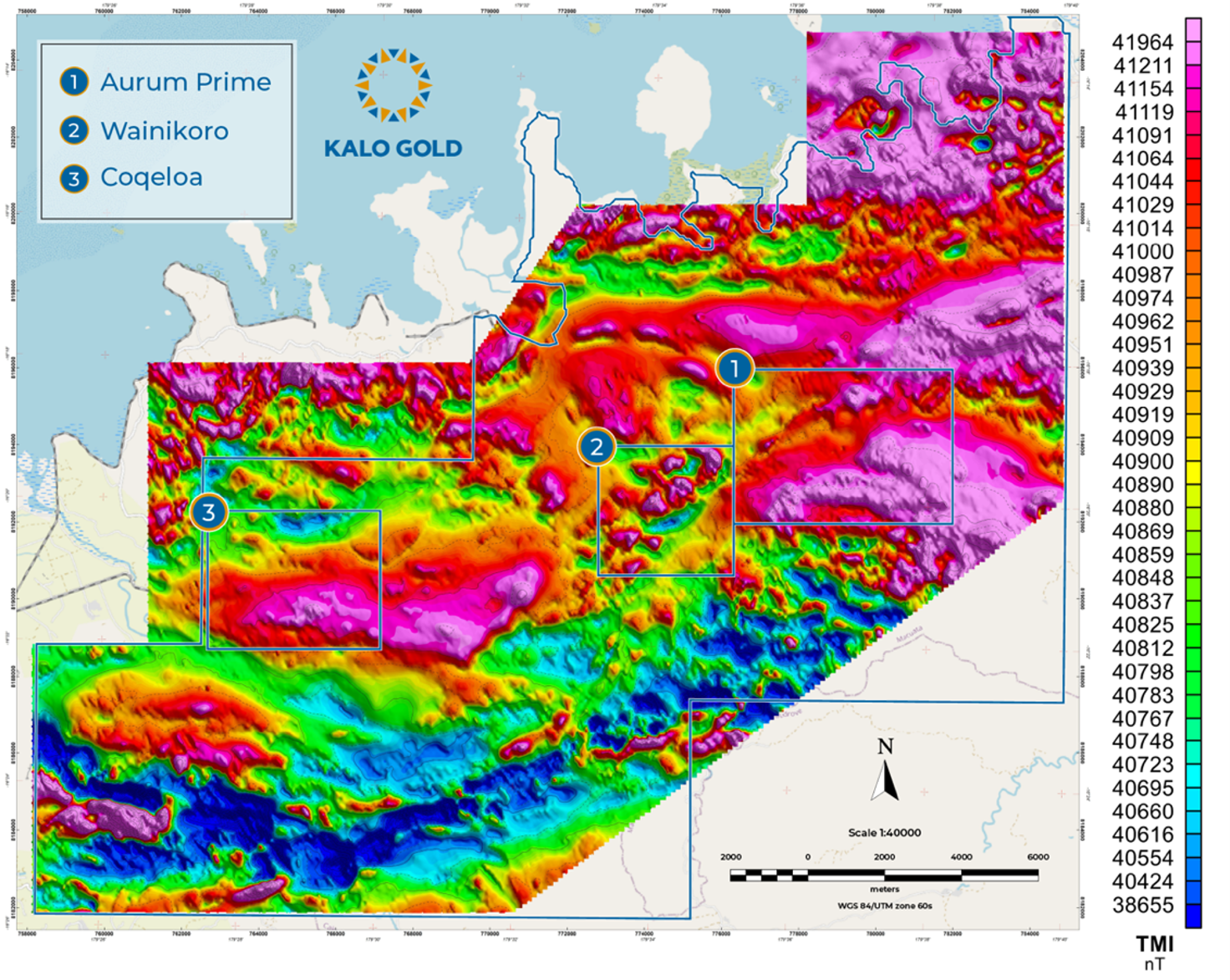
Figure 1. Vatu Aurum Project - total magnetic intensity (TMI) image showing the Wainikoro target (2) in relation to the Aurum Prime (1) and Coqeloa (3) target areas, Vanua Levu, Fiji.
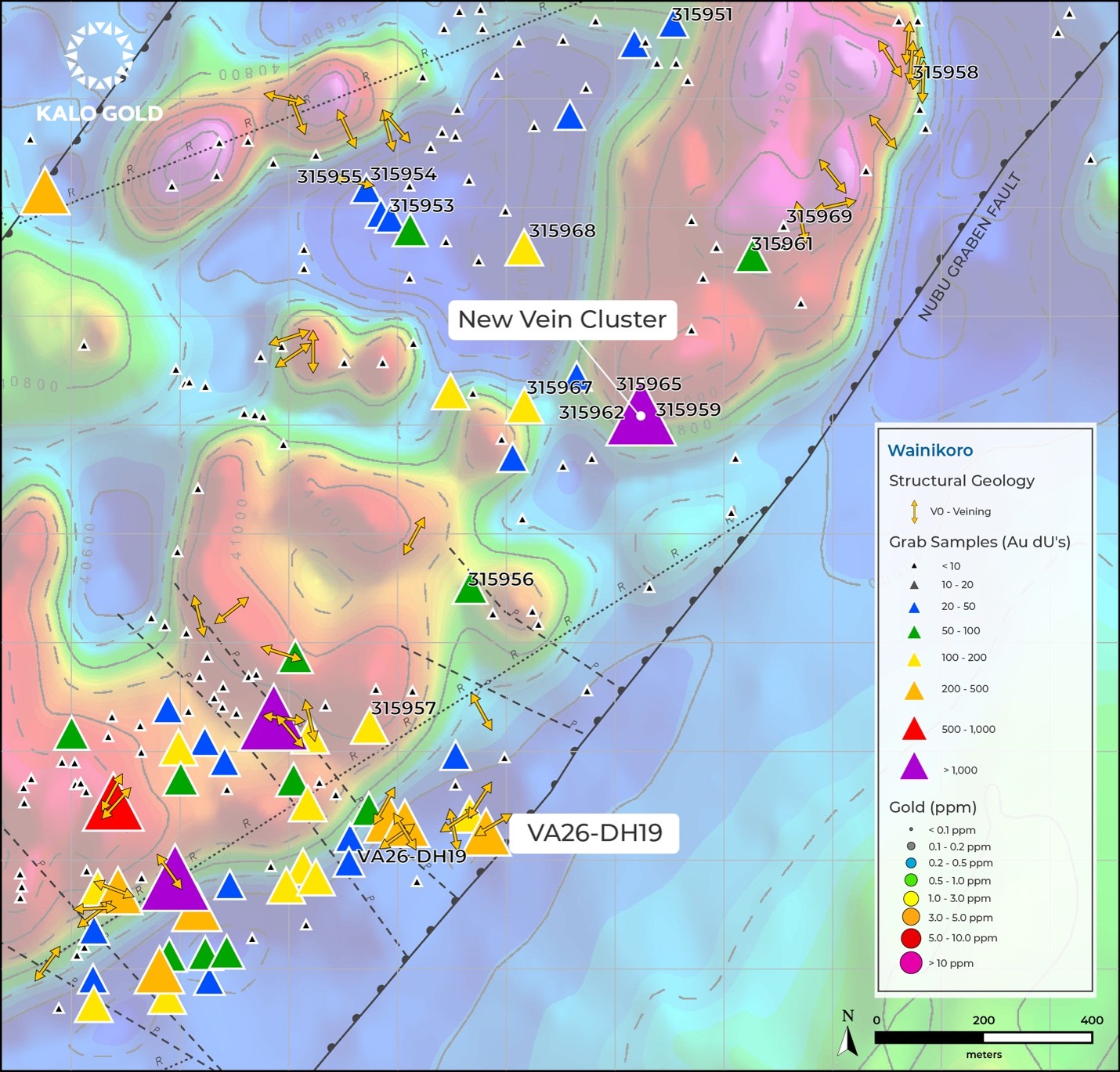
Figure 2. Wainikoro target - gold rock sample results (dUs) on total magnetic intensity (TMI), showing the mapped quartz veins and the principal Wainikoro graben structure.
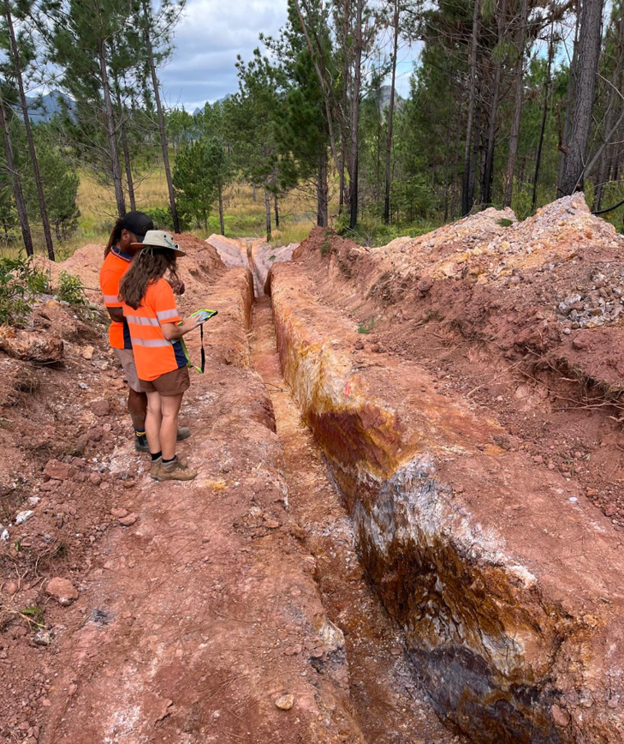
Figure 3. Trench exposure at Wainikoro, looking, showing a resistant silicified zone exposed in the trench floor and wall. Pervasive orange-brown limonite-goethite and dark red-brown hematite staining overprint pale silica-replaced material, developed within deeply weathered andesitic saprolite. Field crew for scale.
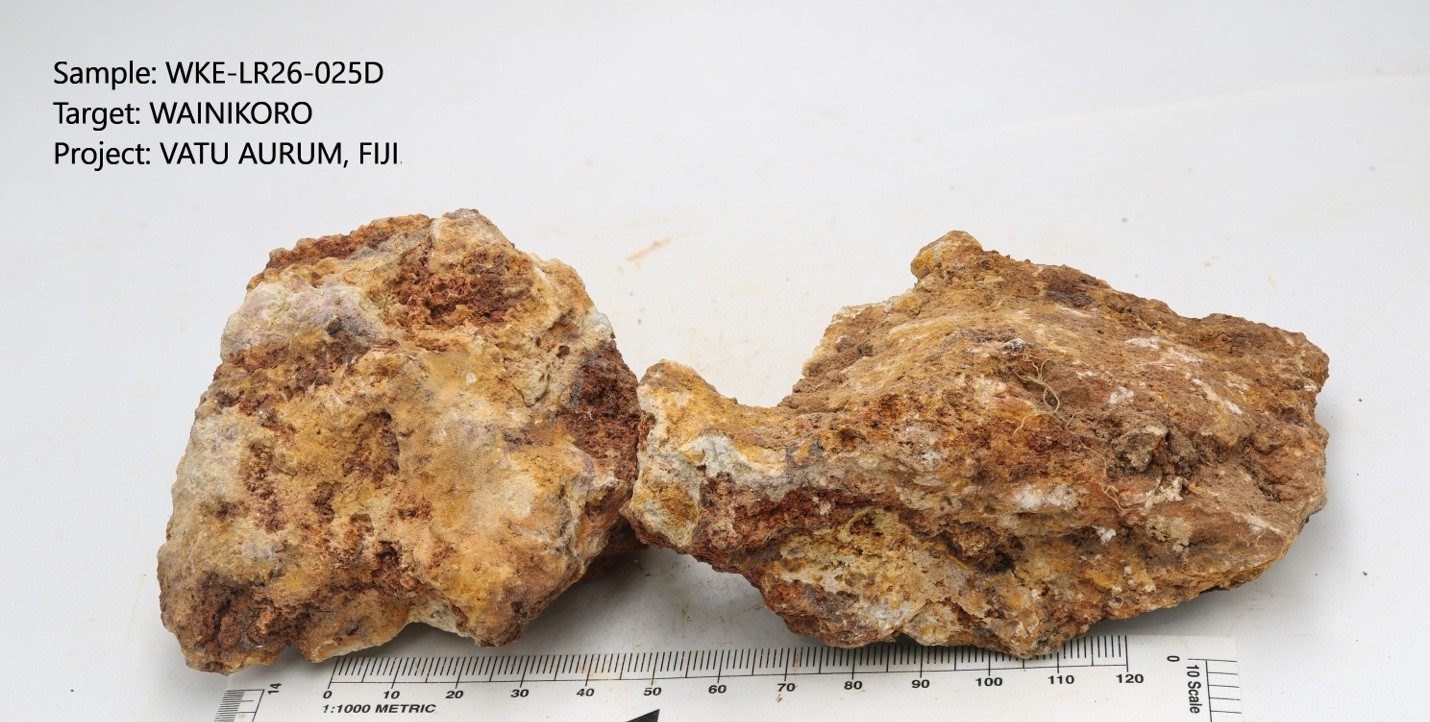
Figure 4. Sample WKE-LR26-025D, Wainikoro - heavily fractured and weathered microcrystalline quartz vein material. Pale green chlorite/celadonite alteration is developed along fractured selvages, strongly overprinted by patchy orange-brown limonite and goethite with sooty manganese oxide infill. This sample returned 4.02 g/t gold (1,406 dUs) and 105 g/t silver. Scale bar 10 cm.
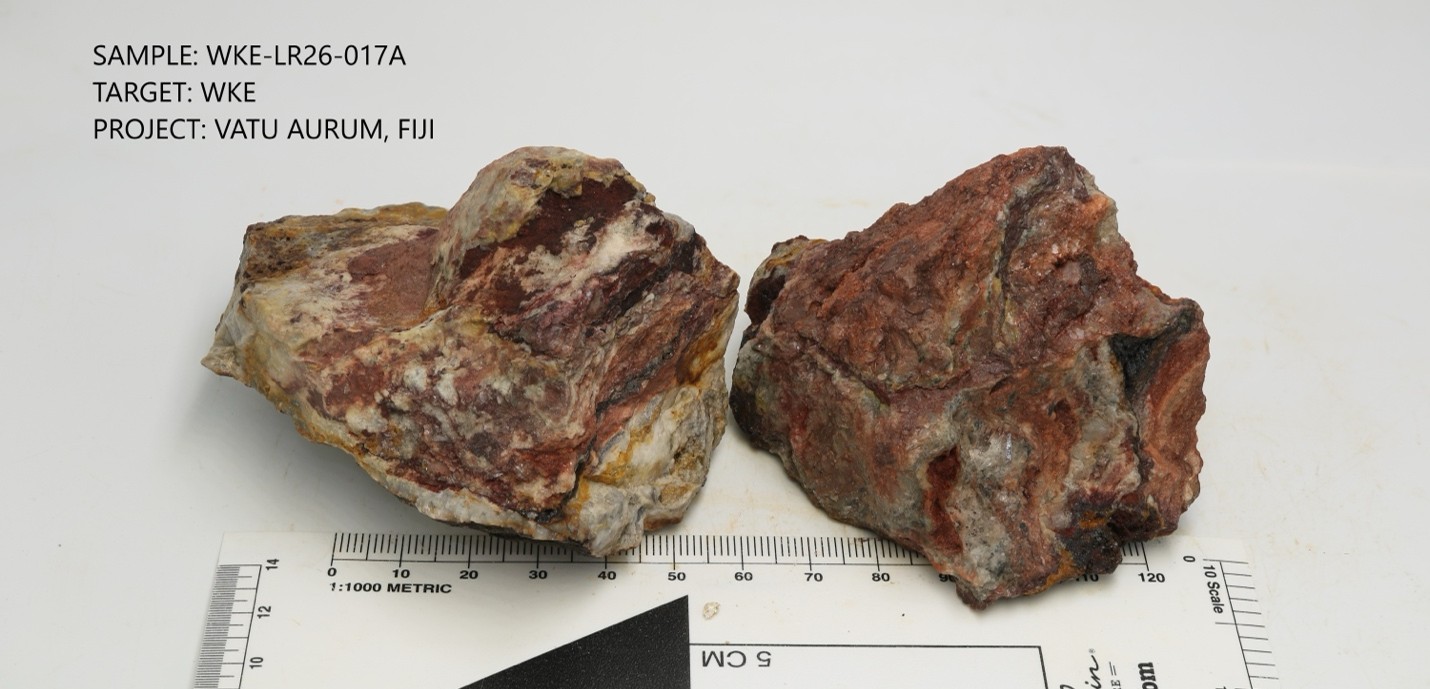
Figure 5. Sample WKE-LR26-017A, Wainikoro - intensely silicified, highly competent microcrystalline andesite in which primary textures have been replaced by fine quartz. Fractures and vugs carry well-developed platy and lattice-bladed quartz, overprinted by dark purple specular hematite, manganese oxides and limonite staining. This sample returned 7.83 g/t gold (5,505 dUs) and 99.7 g/t silver, the highest gold value reported in this news release. Scale bar 10 cm.
SOURCE: Kalo Gold Corp.
View the original press release on ACCESS Newswire