

par Star Copper Corp. (CVE:STCU)
Star Copper Reports First Phase 2 Drill Results Extending Mineralization to West, North and South
Drill Hole S-060 returns 80.30m of 0.508% CuEq within 317.00m of 0.291% CuEq; S-059 returns 109.65m of 0.391% CuEq
VANCOUVER, BC / ACCESS Newswire / March 17, 2026 / Star Copper Corp. (CSE:STCU)(OTCQX:STCUF)(FWB:SOP) ("Star Copper" or the "Company"), a critical minerals exploration and development company, is pleased to announce the first drill results from the 2025 Phase 2 program at its flagship Star Project in northwestern British Columbia.
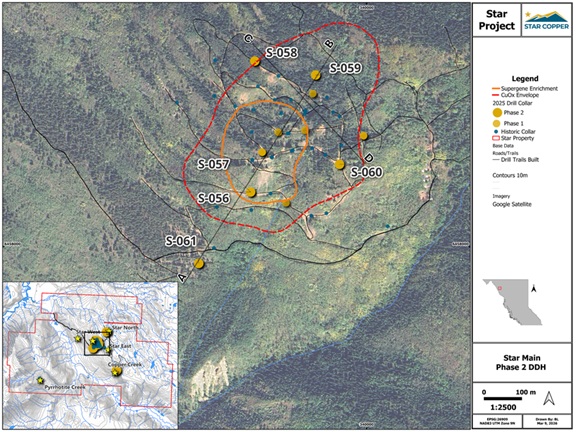
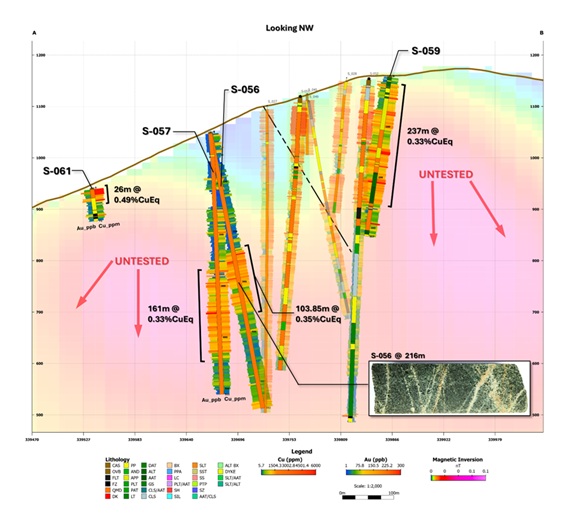
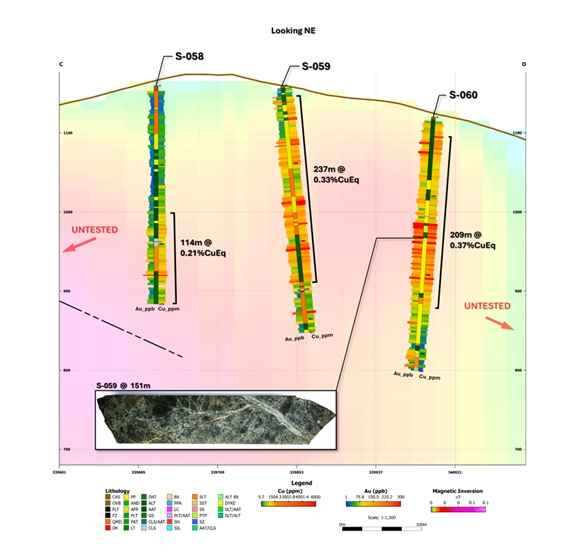
Today's news reports on assay results and geological observations from six Star Main holes, S-056 through S-061 (Figures 1 to 3), drilled to expand the copper-gold system to the west, north and south, and to test the relationship between porphyry-style mineralization, potassic alteration, fault architecture and coincident IP chargeability anomalies.
Highlights
Robust mineralized system which is open in multiple directions
Phase 2 confirmed the Hypogene system is intact and 2026 is the year to expand known zones
3D IP survey to further target deeper extensions and test validity of nested porphyry model
2026 drill season planning already underway with $10 MM committed to the Star Property
"These first Phase 2 results show that Star Main hosts multiple mineralized corridors, not a single isolated panel," said Darryl Jones, CEO of Star Copper. "What is particularly encouraging is the repeatability of the system: where we see the right combination of structure, potassic alteration and quartz-sulphide veining, we continue to intersect broad copper-gold intervals. With fresh flow-through capital now in place, we believe Star is well positioned for a much larger 2026 campaign focused on expanding Star Main and advancing the broader porphyry cluster across the property."
Highlights
Hole S-056 intersected 542m of 0.139% CuEq (0.103% Cu and 0.036 g/t Au) from 8.40m
Including 103m of 0.35% CuEq (0.251% Cu and 0.099 g/t Au) from 241m.
Hole S-057 intersected 508.25m of 0.181% CuEq (0.137% Cu and 0.043 g/t Au) from 3m
Including 161m of 0.329% CuEq (0.232% Cu and 0.095 g/t Au) from 267.00m.
Hole S-058 intersected 269m of 0.141% CuEq (0.114% Cu and 0.027 g/t Au) from 6.60m
Including 69.00m of 0.246% CuEq (0.197% Cu and 0.047 g/t Au) from 177.00m.
Hole S-059 intersected 313m of 0.281% CuEq (0.217% Cu and 0.063 g/t Au) from 3.35m
Including 109m of 0.391% CuEq (0.291% Cu and 0.098 g/t Au) from 142.55m.
Hole S-060 intersected 317m of 0.291% CuEq (0.209% Cu and 0.080 g/t Au) from 5.00m
Including 80m of 0.508% CuEq (0.360% Cu and 0.144 g/t Au) from 134.70m.
Hole S-061 intersected 68.00m of 0.266% CuEq (0.229% Cu and 0.037 g/t Au) from 3.00m
Including 26m of 0.494% CuEq (0.433% Cu and 0.060 g/t Au) from 3.00m.
Phase 2 drilling at Star Main focused on lateral expansion of mineralized corridors to the north, west and south, while also testing deeper hypogene mineralization to better constrain the structural and lithological controls on porphyry Cu-Au mineralization and their relationship to IP chargeability anomalies. The western drill holes (S-056 and S-057) confirmed a broad potassic-altered and chalcopyrite-bearing corridor west of S-055; the northern holes (S-058 through S-060) traced mineralization into volcanic and porphyritic host rocks associated with strong D- and B-type veining; and S-061 provided a shallow southern test of structurally controlled oxide to transitional copper mineralization.
The Phase 2 Star Main results build directly on the Company's Phase 1 success in defining a broad supergene copper footprint and persistent hypogene mineralization at depth. S-056 and S-057 demonstrate that the western corridor remains open and hosts long intervals of chalcopyrite-bearing quartz monzodiorite with consistent K-feldspar alteration. S-058, S-059 and S-060 show that the northern and central parts of Star Main continue to carry copper-gold mineralization through layered volcanic and porphyritic rocks where chargeability, pyrite-chalcopyrite veining and localized potassic overprints coincide. S-061, although short, confirms that near-surface copper persists on the southern side of the system in oxidized and faulted quartz monzodiorite and porphyry.
Table 1 - Star Main Phase 2 Drill Composite Results. Star Copper 2026
Drill Hole ID | From (m) | To (m) | Width (m) | CuEq (%) | Cu (%) | Au (g/t) | Category |
S-056 | 8.40 | 551.00 | 542.60 | 0.139 | 0.103 | 0.036 | Mixed / Hypogene |
including | 233.80 | 551.00 | 317.00 | 0.197 | 0.141 | 0.055 | Hypogene |
including | 241.00 | 334.85 | 103.85 | 0.351 | 0.251 | 0.099 | Hypogene |
S-057 | 3.00 | 511.25 | 508.25 | 0.181 | 0.137 | 0.043 | Hypogene |
including | 151.00 | 428.30 | 277.30 | 0.259 | 0.194 | 0.064 | Hypogene |
including | 267.00 | 428.30 | 161.30 | 0.329 | 0.232 | 0.095 | Hypogene |
S-058 | 6.60 | 276.00 | 269.40 | 0.141 | 0.114 | 0.027 | Mixed / Hypogene |
including | 126.00 | 276.00 | 150.00 | 0.190 | 0.155 | 0.034 | Hypogene |
including | 162.00 | 276.00 | 114.00 | 0.212 | 0.173 | 0.039 | Hypogene |
including | 177.00 | 246.00 | 69.00 | 0.246 | 0.197 | 0.047 | Hypogene |
S-059 | 3.35 | 317.00 | 313.65 | 0.281 | 0.217 | 0.063 | Mixed / Hypogene |
including | 15.15 | 252.20 | 237.05 | 0.326 | 0.247 | 0.078 | Hypogene |
including | 142.55 | 252.20 | 109.65 | 0.391 | 0.291 | 0.098 | Hypogene |
including | 142.55 | 212.00 | 69.45 | 0.413 | 0.306 | 0.104 | Hypogene |
S-060 | 5.00 | 322.00 | 317.00 | 0.291 | 0.209 | 0.080 | Mixed / Hypogene |
including | 23.70 | 233.00 | 209.30 | 0.368 | 0.263 | 0.102 | Hypogene |
including | 134.70 | 215.00 | 80.30 | 0.508 | 0.360 | 0.144 | Hypogene |
including | 134.70 | 177.35 | 42.65 | 0.556 | 0.389 | 0.163 | Hypogene |
S-061 | 3.00 | 71.00 | 68.00 | 0.266 | 0.229 | 0.037 | Supergene / Transitional |
including | 3.00 | 29.00 | 26.00 | 0.494 | 0.433 | 0.060 | Supergene / Transitional |
Table 1 Footnotes: (1) Widths reported are drill widths, true thicknesses are unknown. (2) All assay intervals represent length-weighted averages. (3) Copper equivalent (CuEQ) calculations use metal prices of: Cu US$5.60/lb, and Au US$4350/oz., and conceptual recoveries of: Cu 80%, and Au 80%. Conversion of metals to an equivalent copper grade based on these metal prices is relative to the copper price per unit mass factored by conceptual recoveries for those metals normalized to the conceptualized copper recovery. The metal equivalencies for each metal are added to the copper grade. The general formula for this is: CuEQ% = Cu% + ((Au g/t * Au $ g.*Au Recovery) / (Cu $/t. * 22.046 *Cu Recovery))
Table 2-Collar Table - UTM Zone 9N NAD83. Star Copper 2026
Hole ID | UTM Easting | UTM Northing | Elevation (m) | Azimuth | Dip | Depth (m) |
S-056 | 339693 | 6458145 | 1051 | 000 | -75 | 551 |
S-057 | 339693 | 6458145 | 1051 | 000 | -88 | 511.25 |
S-058 | 339704 | 6458491 | 1166 | 000 | -90 | 276 |
S-059 | 339865 | 6458454 | 1164 | 180 | -80 | 317 |
S-060 | 339928 | 6458218 | 1119 | 265 | -85 | 322 |
S-061 | 339556 | 6457956 | 941 | 320 | -65 | 71 |
Hole S-056 (completed Sep 1, 2025)
Hole S-056 was collared approximately 100 m west of S-055 to test westward continuation of the Star Main mineralized corridor. The hole cut quartz monzodiorite (QMD) from near surface to end of hole, with a broad oxide to transitional profile from 8.4 m to approximately 131 m marked by malachite, azurite, chrysocolla and local tenorite developed along strongly fractured intervals and clay-gouge zones. Below the oxide cap, S-056 entered a long hypogene interval characterized by patchy to vein-controlled K-feldspar alteration, minor to moderate disseminated sulphides, and repeated quartz-carbonate-pyrite-chalcopyrite veining, including a stronger porphyritic QMD phase from roughly 239 m downward. The hole confirms that the western side of Star Main hosts a broad potassic and chalcopyrite-bearing corridor below the supergene profile and provides a strong westward vector for follow-up drilling.
Hole S-057 (completed Sep 14, 2025)
Drilled as a steep fan from the S-056 pad, S-057 was designed to test the continuity and vertical geometry of mineralization within the western Star Main corridor. The hole intersected QMD and minor porphyritic intrusive phases with early pervasive to vein-controlled K-feldspar alteration in the upper part of the hole and long runs of quartz-sericite-chlorite alteration deeper down. Chalcopyrite occurs as fine disseminations and in quartz-pyrite-magnetite-chlorite veins, with Company review also identifying chalcopyrite in early quartz-actinolite-pyrite-epidote veins and as replacement of mafic grains in adjacent halos. Broad mineralized intervals from 151.0 m to 428.3 m, including a stronger core from 267.0 m onward, support the interpretation that the S-056 west panel is part of a sizeable hypogene porphyry corridor rather than an isolated high-grade shoot.
Hole S-058 (completed Oct 3, 2025)
Hole S-058 was drilled vertically approximately 60 m north of historic hole S-037 to test northward continuity of the Star Main system. From surface to about 61 m the hole cut oxidized and fractured QMD, after which it entered a layered sequence of andesite ash tuff, augite-plagioclase porphyry, and lesser laminated sedimentary units. Below roughly 126 m, pyrite and chalcopyrite increase within abundant D-type quartz-pyrite-chlorite-magnetite veins and subordinate B-type quartz veins, with mineralization strengthening downward into the lower half of the hole. S-058 demonstrates that the northern Star Main panel retains the same oxide-to-hypogene transition seen elsewhere on the property and that chargeability-related sulphide veining persists well beyond the shallow oxide horizon.
Hole S-059 (completed Oct 16, 2025)
Hole S-059 tested the central to northern Star Main area across a strongly fractured volcanic and porphyritic package. After passing through oxidized tuffs and porphyritic units in the upper section, the hole entered a better mineralized interval from approximately 142.55 m to 252.2 m hosted in andesite lithic tuff, ash tuff and porphyritic volcanic units. This interval is notable for common pyrite-chalcopyrite D-type veining, local B-type quartz-pyrite-chalcopyrite veins, and a distinct biotite/potassic overprint developed between about 194.3 m and 235.1 m, where matrix biotite and vein-controlled K-feldspar become more pronounced. S-059 confirms that copper-gold mineralization at Star Main is not restricted to intrusive QMD and that volcanic wall rocks adjacent to structures also host broad, chargeability-related porphyry mineralization.
Hole S-060 (completed Oct 25, 2025)
Hole S-060 was drilled on the western-central side of Star Main to test vein density and higher-grade continuity beneath shallow oxidized volcanic rocks. The hole cut andesite ash tuff, lithic tuff, augite-plagioclase porphyry and lesser laminated sedimentary units, with moderate to strong oxidation in the upper section and local malachite-azurite developed around carbonate vein zones. From roughly 126.6 m to 218.9 m, chalcopyrite becomes more consistent in both B-type quartz veins and D-type pyrite-chlorite-chalcopyrite veins, coincident with moderate quartz-sericite-chlorite alteration and localized K-feldspar overprints associated with brecciation, healed shear zones and late carbonate-anhydrite veins. The strongest composite intervals in this release come from S-060, making it an important proof point that Star Main contains multiple structurally prepared panels capable of hosting broad copper-gold mineralization.
Hole S-061 (completed Nov 1, 2025)
Hole S-061 was a short southern Star Main test designed to assess shallow continuity of copper mineralization in oxidized quartz monzodiorite and porphyry. The hole intersected QMD from 3.0 m to 21.85 m followed by plagioclase porphyry and two clay-gouge fault zones from 55.25 m to 61.0 m and 62.0 m to 66.2 m. Near-surface chalcopyrite occurs as blebs replacing mafic minerals and in narrow quartz-pyrite-chalcopyrite veinlets, many of which are oxidized to malachite and lesser azurite; weak K-feldspar selvages are locally developed around early veins in the upper QMD. Although short, S-061 confirms the presence of a shallow structurally controlled copper panel on the southern side of Star Main and highlights a new area for follow-up drilling in 2026.
Key Takeaways
Phase 2 drilling successfully expanded Star Main mineralization westward, northward and southward from the