

par Taranis Resources, Inc. (CVE:TRO)
Taranis Announces New Critical Minerals By-Product Findings at the Thor and Ajax Mines
ESTES PARK, CO / ACCESS Newswire / August 17, 2026 / Taranis Resources Inc. ("Taranis" or the "Company") [TSX.V:TRO][OTCQB:TNREF] is releasing the results of a study of by-product metals found at Thor. Samples were collected from a stockpile of vein material at Thor, and from adit dumps at another historic mine (Ajax) located across a valley. Identical analytical processes were applied to the samples from both locations with results demonstrating that consistent enrichment of epithermal-style precious and critical minerals has occurred at both sample sites. The findings of the study strongly indicate further exploration activities between the two historical mine sites and further indicates that a single enrichment event is responsible for the existence of both mineral deposits.
Background
Taranis has a defined near-surface NI 43-101 Mineral Resource at Thor that includes gold, silver, copper, lead, and zinc as core commodities. The most recent NI-43-101 updated Mineral Resource (see Taranis News Release dated February 26, 2024) was prepared with a focus on these core metals. Two of the existing metals contained in the updated NI 43-101 Mineral Resource are defined as Critical Minerals by the Canadian Federal Government (copper and zinc). Several other critical minerals are present in the Thor mineral resource, including indium, antimony, and gallium. The Canadian Federal Government announced an agreement with the Canada Growth Fund in July 2026 to fund local (Trail, BC) processing capacity for these three elements.
Being a polymetallic deposit, Thor contains other metals of value commonly called ‘by-product metals', and these typically only occur in minor concentrations. These are metals that could never be economically mined for their own sake - but are recovered incidentally with the core metals. This means that the ability to recover these by-product minerals is only feasible if the main metals in the deposit are economic to mine.
Context of Critical Mineral Sampling Undertaken
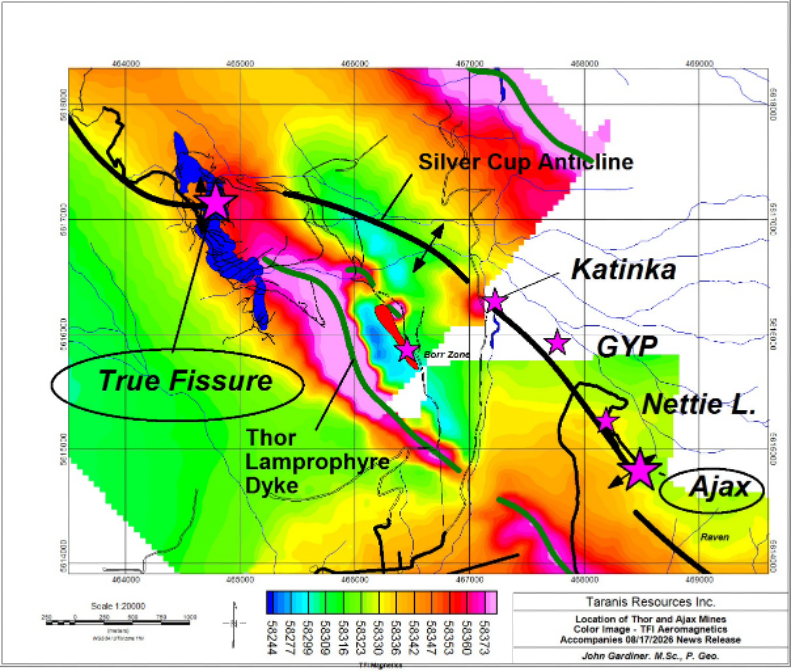
Taranis investigated ‘by-product' metals at both the Thor and Ajax deposits, which are located within the expanded Thor property (6,470 ha). The samples are selective and are not representative of the average metal content of the deposits. The True Fissure samples were collected at the Thor open pit (464782E, 5617129N), and the Ajax samples were taken from 468477E, 5614842N UTM Zone 11N).
At Thor, sampling was conducted in the True Fissure zone, which forms part of the existing Thor Mineral Resource. The data presented here identify ‘by-product' metals that occur in sufficient quantities to warrant consideration as by-product metals, but further study is needed to establish average concentrations.
The current updated Mineral Resource at Thor includes gold, silver, copper, lead, and zinc; however, the sampling discussed in this News Release suggests that indium, cadmium, antimony, and other metals should be considered in future Mineral Resource updates. Properly assessing the quantities of by-product metals in the Thor deposit will require additional, highly specialized analytical techniques that have not been systematically applied at Thor. Taranis has permitted a 10,000-tonne bulk sample that would more accurately define the concentration, mode, and occurrence of these by-product metals.
The discovery of broad similarity between material at Thor and Ajax has important implications for future exploration, as it suggests the deposits originated from the same source - most likely an intrusive body (or series of intrusive bodies) located in contact with the Silver Cup Anticline (see the figure that accompanies this News Release).
Ajax Mine
The Ajax Mine is located 4.4 km east-southeast of the Thor Deposit, across Ferguson Creek. Taranis owns contiguous Mineral Tenures that cover both the Thor and Ajax mines. No NI 43-101 Mineral Resource has ever been completed at Ajax or the adjacent Nettie L. Mine. Ten (10) samples were collected from the dumps found at Ajax, and the rocks were sawed in half, petrographically described, and subjected to multiple types (see analytical methods outlined below) of analysis to ascertain the presence of ‘by-product' metals.
The Ajax Mine can be described as a high-grade precious and base metal deposit of epithermal character. As with Thor, the main metals of interest in the deposit are gold, silver, copper, lead and zinc:
Ajax Mine | Gold (g/t) | Silver (g/t) | Copper (%) | Lead (%) | Zinc (%) | Sulfur (%) |
Average | 3.62 | 94 | 0.3 | 2.2 | 15.2 | 22.8 |
Minimum | 0.02 | 1 | 0.0 | Trace | Trace | 0.1 |
Maximum | 19.9 | 295 | 2.2 | 17.9 | 56.3 | 44.2 |
By-product metals of interest include the following, and those that are listed as being Critical Minerals in Canada are marked by an asterisk (*):
Cadmium (ppm) | Gallium* (ppm) | Indium* (ppm) | Gadolinium (ppm) | Neodymium* (ppm) | Antimony* (ppm) | Tin* (ppm) | |
Average (10 samples) | 1,051 | 4.32 | 94.8 | 9.23 | 60.5 | 208 | 126.6 |
Minimum | 0 | 0.61 | 0.1 | 0.50 | 4.8 | 2.8 | 3.1 |
Maximum | 3,860 | 10.60 | 350 | 38.10 | 247 | 1,130 | 410.0 |
Additional work is required to find out how these by-product metals occur in the Ajax Deposit. In general, it is understood that indium occurs with sphalerite, and both cadmium and antimony occur with tetrahedrite (silver). It is unknown which minerals host gallium, neodymium and tin, nor if they are potentially important by-products of precious and base metal extraction.
Thor Deposit
Taranis has established an NI 43-101 Updated Mineral Resource at Thor. The precious metal content (gold and silver) is well-documented, as are the base metals copper, lead and zinc. The following table shows the average content of these metals from thirteen (13) samples collected from the True Fissure Open Pit.
True Fissure | Gold (g/t) | Silver (g/t) | Copper (%) | Lead (%) | Zinc (%) | Sulfur (%) |
Average (13 samples) | 2.18 | 335 | 0.6 | 8.6 | 22.1 | 23.0 |
Minimum | 0.19 | 29 | 0.1 | tr | 0.3 | 13.6 |
Maximum | 4.16 | 1,000 | 2.5 | 30.0 | 41.9 | 39.3 |
By-product metals of interest include the following, and those that are listed as being Critical Minerals in Canada are marked by an asterisk (*):
Cadmium (ppm) | Gallium* (ppm) | Indium* (ppm) | Gadolinium (ppm) | Neodymium* (ppm) | Antimony* (ppm) | Tin* (ppm) | |
Average | 1,420.6 | 5.7 | 18.4 | 0.3 | 0.9 | 1,020. | 47.8 |
Minimum | 18.6 | 0.7 | 0.3 | <0.1 | <0.1 | 64.5 | 3.5 |
Maximum | 2,840.0 | 11.9 | 62.1 | 1.0 | 5.1 | 4,290 | 102.0 |
Thor contains similar levels of ‘by-product' metals, albeit slightly higher levels of antimony than the Ajax deposit samples.
Discussion
Despite lateral separation of 4.4 km, both Thor and Ajax have comparable metal contents, including potential by-product metals. In-depth analytical work and strong domestic investment in processing technologies suggest that antimony, indium and cadmium should be examined as ‘by-product' metals in future updates to the Thor Mineral Resource. Gallium and tin also occur in both Thor and Ajax, but their habits and recoverability are enigmatic at this point. One point of difference between the deposits is the lack of neodymium and gadolinium at Thor.
Thor is a relatively unusual deposit in that it contains many different core metals. It is located near surface and is relatively high-grade compared to other deposits commonly found in British Columbia. High-grade mineral deposits are extremely valuable - even when size is small - because the value per tonne is high and the surface footprint of the mine is considerably smaller than a large, low grade, bulk mineable deposit.
Sampling outlined in this report suggests that even higher value/tonne can be reasonably inferred by considering the contributions of ‘by product' metals. Deposits such as Thor and Ajax are strategically valuable deposits because they are literally a ‘one-stop shop' for many of Canada's favourite precious metals, alongside increasingly in-demand Critical Minerals.
Quality Control and Laboratory Methods
All samples for the Thor project are securely delivered to Actlabs in Kamloops, British Columbia.
Analytical work was completed both at the Kamloops, and Ancaster, Ontario locations. Actlabs is ISO 17025 accredited. Rock Samples are bagged and identified with a laboratory ticket, and the location of the samples is noted with a differential GPS unit. Samples were analyzed for 42 elements by 4-Acid Digestion / Inductively Coupled Plasma - Mass Spectrometry ("ICP-MS") and for gold by 30g Fire Assay / Atomic Absorption Spectrophotometry ("AAS"). In addition to this, the samples were also analyzed using Instrumental Neutron Activation Analysis ("INAA/FINA") to determine osmium, ruthenium, rhodium, platinum and palladium content. Overlimit silver, lead, zinc and sulfur determinations were analyzed using a combination of gravimetric and "total" Fusion ("Peroxide ICP-OES") methods.
Qualified Person
Exploration activities at Thor were overseen by John Gardiner (P. Geo.), who is a Qualified Person under the meaning of Canadian National Instrument 43-101. John Gardiner is the principal of John J. Gardiner & Associates, LLC which operates in British Columbia under Firm Permit Number 1002256. Mr. Gardiner is the President and CEO of Taranis Resources Inc. and has reviewed and approved the comments contained within this News Release.
About Taranis Resources Inc.
Taranis Resources (TSX.V: TRO | OTCQB: TNREF) has evolved beyond the profile of a traditional junior explorer. After 15 years of methodical exploration and compiling a massive database from over 250 drill holes to define a 43-101 Mineral Resource at Thor and recently completing a 100% consolidation of the historic Silver Cup Mining District, the company is transitioning from "understanding the Thor deposit" to "unlocking district-scale" discovery potential.
Taranis' core values include scientific rigor, highlighting exploration driven by state of art predictive targeting, 3-D geophysical inversions, and carefully controlled use of AI, as opposed to traditional surface-level prospecting. The Company prioritizes methodological, high-quality exploration over promotional shortcuts, and allocates funds "into the ground". Taranis' leadership has unmatched shareholder alignment, and our Management Team has been intact for 20 years with substantial insider ownership. Taranis exercises responsible stewardship and is committed to defining legitimate ownership through active labour, stringent reclamation programs, and transparent First Nations and local community engagement.
Taranis currently has 104,452,053 shares issued and outstanding (122,608,613 shares on a fully-diluted basis).
TARANIS RESOURCES INC.
Per: John J. Gardiner (P. Geo.), President and CEO
For further information contact:
John J. Gardiner |
NEITHER THE TSX VENTURE EXCHANGE NOR ITS REGULATION SERVICES PROVIDER (AS THAT TERM IS DEFINED IN THE POLICIES OF THE TSX VENTURE EXCHANGE) ACCEPTS RESPONSIBILITY FOR THE ADEQUACY OR ACCURACY OF THIS NEWS RELEASE.
This News Release may contain forward looking statements based on assumptions and judgments of management regarding future events or results that may prove to be inaccurate as a result of factors beyond its control, and actual results may differ materially from expected results.
SOURCE: Taranis Resources, Inc.
View the original press release on ACCESS Newswire